
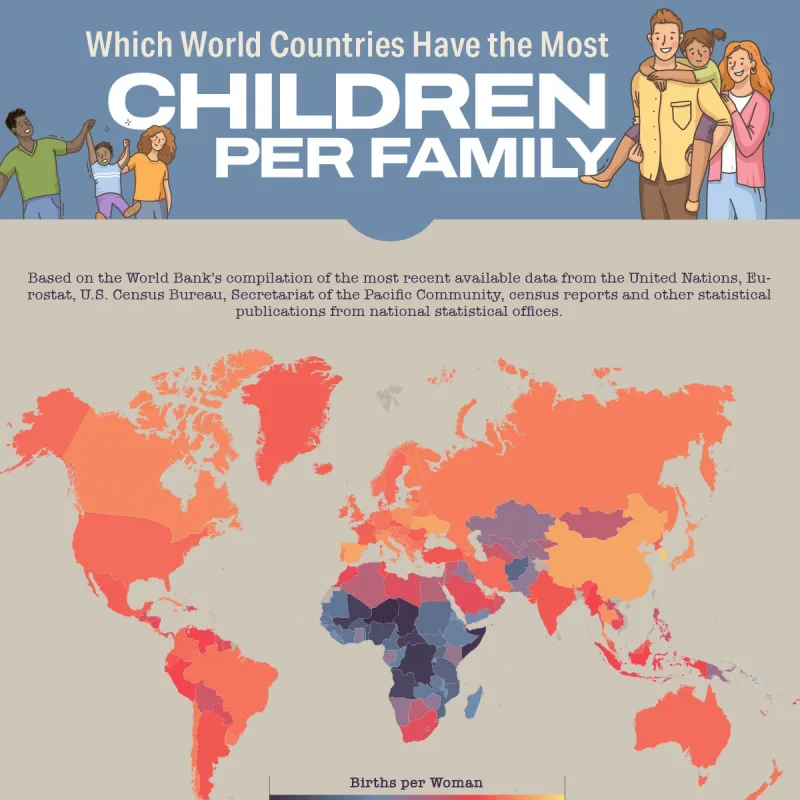
Fertility rates vary greatly around the world. From affordable healthcare access to cultural and religious preferences, there are many factors that determine how many children families have. Do you know which countries have the most and least children?
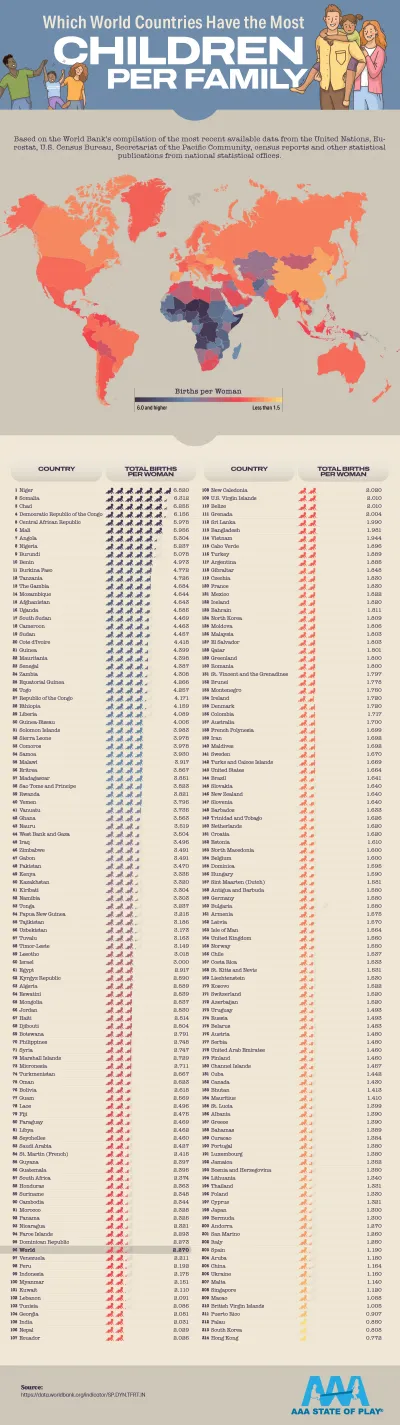
The team at AAA State of Play looked at data for birth rate by country to determine which countries have the most children per family around the planet. The data is based on the World Bank's data on fertility rates and total births to women in each country.
Embed this image on your site:
The Birth Rate in Countries Around the World
The country with the highest birth rate according to the data is Niger. The fertility rate in Niger is 6.8 children per family. The next countries on the list with the highest fertility rate are Somalia and Chad, both located in Africa. Somalia and Chad have a birth rate of 6.3 children per family.
The rest of the countries in the top 10 include the Democratic Republic of the Congo (6.2 children), Central African Republic (6.0 children), Mali (6.0 children), Angola (5.3 children), Nigeria (5.1 children), Burundi (5.0 children), and Benin (5.0). Many sub-Saharan countries have higher fertility rates than other countries around the world.
According to the data, the countries with the lowest number of children per family are Hong Kong (0.8 children), South Korea (0.8 children), Palau (0.8 children), Puerto Rico (0.9 children), and the British Virgin Islands (1.0 children).
Why Do Some Countries Have More Children per Family Than Others?
What contributes to higher or lower birth rates in countries? There are many factors that can impact the number of children families have including:
- Access to contraception and birth control
- Age of marriage and childbearing
- Cultural preference for children
- Economic status
- Education options for women
- Availability of affordable prenatal and neonatal healthcare
- Infertility and difficulty conceiving
- Personal choice for children
Finance plays a big part in many families' ability or choice to have children. Families that have limited affordable access to healthcare, birth control, and fertility options can have a significant role in how many children they have. Affordable contraception is not always available to families and may lead to a higher number of children per family. On the other hand, some families struggle with infertility and may not be able to have children or as many as they'd like to. Fertility options like in vitro fertilization can be expensive and unavailable to families depending on their location or accessibility to the treatments.
How Different Areas of the World Rank
Based on the data from the World Bank, the average birthrate worldwide is 2.3 children per family. This is how some of the different regions of the world stack up:
- Sub-Saharan Africa: 4.6
- Middle East & North Africa: 2.6
- South Asia: 2.2
- Latin America & Caribbean: 1.9
- Europe & Central Asia: 1.7
- North America: 1.6
- East Asia & Pacific: 1.5
Children per Family Based on Economic Standing
The following is the breakdown of children per family around the world based on their economic status:
- Low income: 4.6 children per family
- Lower middle income: 2.6 children per family
- Low & middle income: 2.4 children per family
- Middle income: 2.1 children per family
- Upper middle income: 1.6 children per family
- High income: 1.5 children per family
The Cost of Raising a Child
In the United States, the average cost of raising a child could be up to $300,000 over the course of their lifetime. Of course this depends on location and many other factors, but the fact of the matter is that kids can cost caregivers a bundle. The cost of raising a child has a large impact on many family's decisions and ability to have children. In addition to the costs of healthcare for pregnant mothers and their subsequent children, there are many other expenses. Diapers, formula, childcare, and clothing make up a significant portion of a child's budget early in life. Later on, the costs of sports, extracurricular activities, and education become additional expenses that can greatly tap into parents' and caregivers' bank accounts. Some additional costs of raising children include activities at home. Things like toys, games, playground structures, and art supplies can be costly.
Countries With the Most and Least Children per Family
Country
Births per Woman
Niger
6.8
Somalia
6.3
Chad
6.3
Democratic Republic of the Congo
6.2
Central African Republic
6
Mali
6
Angola
5.3
Nigeria
5.2
Burundi
5.1
Benin
5
Burkina Faso
4.8
Tanzania
4.7
The Gambia
4.7
Mozambique
4.6
Afghanistan
4.6
Uganda
4.6
South Sudan
4.5
Cameroon
4.5
Sudan
4.5
Cote d'Ivoire
4.4
Guinea
4.4
Mauritania
4.4
Senegal
4.4
Zambia
4.3
Equatorial Guinea
4.3
Togo
4.3
Republic of the Congo
4.2
Ethiopia
4.2
Liberia
4.1
Guinea-Bissau
4
Solomon Islands
4
Sierra Leone
4
Comoros
4
Samoa
3.9
Malawi
3.9
Eritrea
3.9
Madagascar
3.9
Sao Tome and Principe
3.8
Rwanda
3.8
Yemen
3.8
Vanuatu
3.7
Ghana
3.6
Nauru
3.5
West Bank and Gaza
3.5
Iraq
3.5
Zimbabwe
3.5
Gabon
3.5
Pakistan
3.5
Kenya
3.3
Kazakhstan
3.3
Kiribati
3.3
Namibia
3.3
Tonga
3.2
Papua New Guinea
3.2
Tajikistan
3.2
Uzbekistan
3.2
Tuvalu
3.2
Timor-Leste
3.1
Lesotho
3
Israel
3
Egypt
2.9
Kyrgyz Republic
2.9
Algeria
2.9
Eswatini
2.8
Mongolia
2.8
Jordan
2.8
Haiti
2.8
Djibouti
2.8
Botswana
2.8
Philippines
2.7
Syria
2.7
Marshall Islands
2.7
Micronesia
2.7
Turkmenistan
2.7
Oman
2.6
Bolivia
2.6
Guam
2.6
Laos
2.5
Fiji
2.5
Paraguay
2.5
Libya
2.5
Seychelles
2.5
Saudi Arabia
2.4
St. Martin (French)
2.4
Guyana
2.4
Guatemala
2.4
South Africa
2.4
Honduras
2.4
World
2.3
Suriname
2.3
Cambodia
2.3
Morocco
2.3
Panama
2.3
Nicaragua
2.3
Faroe Islands
2.3
Dominican Republic
2.3
Venezuela
2.2
Peru
2.2
Indonesia
2.2
Myanmar
2.2
Kuwait
2.1
Lebanon
2.1
Tunisia
2.1
Georgia
2.1
India
2
Nepal
2
Ecuador
2
New Caledonia
2
U.S. Virgin Islands
2
Belize
2
Grenada
2
Sri Lanka
2
Bangladesh
2
Vietnam
1.9
Cabo Verde
1.9
Turkey
1.9
Argentina
1.9
Gibraltar
1.8
Czechia
1.8
France
1.8
Mexico
1.8
Iceland
1.8
Bahrain
1.8
North Korea
1.8
Moldova
1.8
Malaysia
1.8
El Salvador
1.8
Qatar
1.8
Greenland
1.8
Romania
1.8
St. Vincent and the Grenadines
1.8
Brunei
1.8
Montenegro
1.8
Ireland
1.7
Denmark
1.7
Colombia
1.7
Australia
1.7
French Polynesia
1.7
Iran
1.7
Maldives
1.7
Sweden
1.7
Turks and Caicos Islands
1.7
United States
1.7
Brazil
1.6
Slovakia
1.6
New Zealand
1.6
Slovenia
1.6
Barbados
1.6
Trinidad and Tobago
1.6
Netherlands
1.6
Croatia
1.6
Estonia
1.6
North Macedonia
1.6
Belgium
1.6
Dominica
1.6
Hungary
1.6
Sint Maarten (Dutch)
1.6
Antigua and Barbuda
1.6
Germany
1.6
Bulgaria
1.6
Armenia
1.6
Latvia
1.6
Isle of Man
1.6
United Kingdom
1.6
Norway
1.6
Chile
1.5
Costa Rica
1.5
St. Kitts and Nevis
1.5
Liechtenstein
1.5
Kosovo
1.5
Switzerland
1.5
Azerbaijan
1.5
Uruguay
1.5
Russia
1.5
Belarus
1.5
Austria
1.5
Serbia
1.5
United Arab Emirates
1.5
Finland
1.5
Channel Islands
1.5
Cuba
1.4
Canada
1.4
Bhutan
1.4
Mauritius
1.4
St. Lucia
1.4
Albania
1.4
Greece
1.4
Bahamas
1.4
Curacao
1.4
Portugal
1.4
Luxembourg
1.4
Jamaica
1.4
Bosnia and Herzegovina
1.4
Lithuania
1.3
Thailand
1.3
Poland
1.3
Cyprus
1.3
Japan
1.3
Bermuda
1.3
Andorra
1.3
San Marino
1.3
Italy
1.3
Spain
1.2
Aruba
1.2
China
1.2
Ukraine
1.2
Malta
1.1
Singapore
1.1
Macao
1.1
British Virgin Islands
1
Puerto Rico
0.9
Palau
0.8
South Korea
0.8
Hong Kong
0.8
Find more about the author: Kim Hart