
Buyer: Parks & Recreation Directors, Parks Superintendents, Municipal Operations Managers, Public Facilities Managers
Primary Risk: Preventable injury exposure, shutdowns, and corrective rework after installation or incident review
Applies to: ASTM F1487, ASTM F1292, CPSC Public Playground Safety Handbook, DOJ 2010 ADA Standards (where applicable)
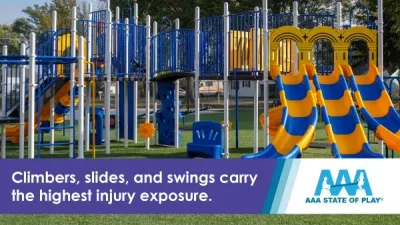
Where Injury Exposure Concentrates on Public Playgrounds
For Parks & Recreation Directors and Municipal Operations Managers, “highest injury risk” is usually asked as an equipment question. In practice, playground injury risk is evaluated as an outcome: whether playground equipment can be operated in public use with predictable controls for falls, impacts, and known playground hazards. Many playground related injuries trace back to a short list of conditions that are easy to miss during procurement: fall height that is not matched to surfacing performance, moving play equipment installed without adequate clearance, or site details that create hard contact points.
Not all playgrounds present the same exposure. Risk concentrates where elevated play equipment and motion overlap with inconsistent surfacing, mixed-age circulation, and incomplete installation verification. When injuries occurring on a site trigger review, the buyer is expected to show that design choices were standards-aligned and that the installed condition matched what was approved.
Why Post-Incident Review Becomes a Municipal Project File
Public playground projects are judged after the fact. A single serious injury can convert routine playground safety questions into a formal review of records, maintenance, and compliance assumptions. After a reportable incident, playground-related reviews often cite the Consumer Product Safety Commission handbook and national resource center guidance alongside ASTM expectations. If severe injuries occur, municipal staff are often asked to explain why the playground design, surfacing selection, and installation acceptance were treated as sufficient for the site’s use level, including school playground injuries at elementary schools where peak volume is predictable.
Inspection and acceptance issues rarely show up as “bad equipment.” They show up as rework: correcting a use zone conflict, rebuilding borders that create trip or impact points, or replacing surfacing after a playground fall exposes a hard base. The same project can be “approved” on paper and still produce playground injuries if the installed condition deviates from the documented assumptions. The cost is not only corrective work. The cost is loss of availability, board questions, and a public record that reads as preventable.
Decision Factors That Determine Injury Outcomes
Playground injury risk is not evenly distributed across components. It clusters around equipment types that combine height, speed, and contact potential, and around risk factors that determine how child falls are absorbed and where collisions can occur. Four decision factors consistently determine whether playground injuries remain low and whether playground-related injuries can be defended under inspection and post-incident review.
Fall height and impact attenuation alignment
Elevated platforms, slides, and climbing equipment drive a large share of severe injuries because they introduce predictable fall heights. The key control is not the component label. It is whether the maximum fall height was verified and the surfacing system was specified and maintained to perform at that height. ASTM F1292 is used to evaluate impact attenuation, and ASTM F1487 establishes requirements that tie surfacing and fall height to the play equipment installed. Loose-fill systems such as wood chips can be compliant in concept and still fail in practice when displacement exposes compacted soil or a hard base.
A defensible file treats fall height, test basis, and maintenance expectations as part of the playground equipment scope, not an afterthought. (See ASTM F1487 Explained.)
Use zones and clearance for moving equipment
Swings, rotating elements, and other moving play equipment create a different injury pattern than static structures. The hazard is not only a child falls event. It is contact with a moving element, a shared path, or adjacent components that sit inside the required use zone. In public sites, layout errors tend to be repeatable. If a swing bay crosses an accessible route or a spinner edge overlaps a slide exit, playground injuries can recur under the same geometry because the layout does not change.
Design reduces playground injury risk when clearance is treated as a measurable requirement during layout review, with no encroachments added during installation. This is a frequent source of post-install corrective work because it is easy to “make it fit” on paper.
Elimination of hard contact points and installation hazards
Some of the highest consequence playground injuries come from hard contact points that are not part of the play intent. Exposed concrete footings, protruding borders, and unmanaged transitions at surfacing edges convert routine falls into serious injury events. These are often treated as “site work” items and left outside the main playground equipment discussion, even though they sit inside fall and circulation areas used by young children.
Design reduces playground injury risk when edge conditions, footings, and transitions are documented as installed acceptance conditions. The objective is not aesthetics. The objective is the removal of known hard-contact risk factors that increase injury severity.
Age zoning and predictable circulation
Age-appropriate equipment is not a label applied at the end. It is a zoning decision that controls who uses which elements, how fast movement occurs, and where conflicts form. Not all playgrounds fail because of one “dangerous” component. Many fail because young children are routed through older-age climbing and swinging zones, or because the site has one high-demand path that concentrates congestion. In school environments, mixing age groups without separation is a common contributor to school playground injuries because use is dense and supervision ratios are fixed.
Playground design that reduces playground injury risk uses clear zoning, sightline-aware circulation, and separation of high-motion elements from entry and gathering zones. The point is to reduce predictable conflict points before they become repeat patterns.
Recurring Conditions Behind Documented Injury Cases
The same failure modes appear across incident reviews and corrective scopes because the mechanisms are consistent.
- Elevated play equipment is selected without verifying critical fall height and surfacing performance, leading to severe injuries after a playground fall.
- Moving play equipment use zones overlap pathways or adjacent components, producing contact injuries that recur under the same layout.
- Loose-fill surfacing is installed but not maintained; displacement exposes hard areas, increasing playground injury risk during child falls.
- Borders, anchors, or exposed concrete footings remain within circulation or fall areas, creating preventable hard-contact playground hazards.
- Age ranges are mixed without zoning, increasing playground-related injuries where young children and older users compete for the same entry and exit points.
Acceptance Conditions That Reduce Repeatable Injury Exposure
Defensible reductions in playground injury risk come from treating injury controls as acceptance conditions, not operational preferences. The project record should identify the highest-risk play equipment by mechanism (height, motion, and contact potential) and then document the controls that were used: verified fall height, surfacing system, and test basis, required use zones, and age-range zoning assumptions. Where loose-fill is used, the maintenance condition is part of compliance, not a separate parks task.
Installation verification matters because the inspection review focuses on the installed condition. A design that assumes clearances, transitions, and compliant surfacing will not reduce playground injuries if field changes introduce conflicts. The goal is predictable public use, with a file that shows what was reviewed, what was installed, and what was accepted.
What This Means for Parks and Facilities Decision-Makers
For Parks & Recreation Directors and Public Facilities Managers, “highest injury risk” should be translated into decision controls that can be shown later.
- Treat playground injury risk as a documented outcome tied to measurable risk factors, not a component preference.
- Prioritize fall-height and surfacing alignment for elevated playground equipment and climbing equipment where child falls are predictable for young children.
- Keep moving play equipment use zones clear of routes, entries, and adjacent structures to reduce repeat injury patterns.
- Require installed acceptance checks for transitions, borders, and hard-contact points that drive severe injuries.
- Plan zoning so young children are not routed through older-age movement zones in parks and at elementary schools.
Next Step
If you need an inspection-aligned reference for how fall height, surfacing, and use zones are evaluated and documented for acceptance, review the ASTM certification process.
Learn About the Author

Mandy Jordan
Mandy has been a playground salesperson and CPSI-certified playground inspector for 12 years. Her passion for play shines through her work, and with years of experience in the playground world, her knowledge of playground safety is unparalleled. In her free time, Mandy enjoys watching her kids play baseball.