

Associative play is the stage where children interact with peers during play without agreeing on rules, roles, or a shared goal, and it typically shows up between ages 3 and 4. It's the fifth of six play stages identified by sociologist Mildred Parten in 1932, and it sits directly between playing alongside other kids and genuinely playing with them.
This guide explains what associative play looks like, how it differs from the stages around it, why it matters developmentally, and how to set up a space that encourages it.
What is associative play?
Associative play happens when children talk, share materials, and influence each other's activities while each one stays focused on their own project. Two four-year-olds at a sand table might trade shovels and comment on each other's tunnels without ever building the same tunnel. The social exchange is real; the shared objective isn't there yet.
This stage marks a genuine shift in social awareness. Children start treating peers as part of the play experience rather than as background, which is the groundwork for the structured group activities that come later. A child who was content to dig alone at two will now want someone nearby to talk to at four.
The loose organization is the defining feature. There's no captain, no teams, and no agreed-upon rules, so conflicts tend to be brief and about materials rather than about fairness. That informality is exactly why the stage works as practice.
How does associative play differ from parallel and cooperative play?
The distinction comes down to interaction and shared goals. Parallel play involves children using similar materials side by side with little interaction. Associative play adds the conversation and the sharing. Cooperative play adds a common objective and rules everyone follows.
Here's the progression in practice:
Parallel play puts two children at the same table with the same blocks, each building separately and barely speaking.
Associative play has those children talking about their towers, borrowing pieces from each other, and reacting to what the other is making.
Cooperative play has them deciding to build one castle together, dividing the work, and agreeing on what counts as finished.
Children move between these stages rather than graduating from one to the next permanently. A five-year-old capable of cooperative play will still drop into associative or solitary play depending on mood, fatigue, and who else is around. Seeing a range of stages in one preschool classroom is normal.
What are the benefits of associative play?
Associative play builds the social machinery children need before group activities can work at all. A child who hasn't practiced initiating conversation with a peer will struggle with a game that requires negotiating rules.
The development happens across several areas:
Social interaction improves as children practice starting conversations, responding to peers, and reading how those exchanges are going.
Language development accelerates because informal play produces constant narration, storytelling, and new vocabulary in context.
Problem-solving grows as children test choices and adjust their behavior based on how other kids react.
Emotional confidence builds through low-stakes group settings where nothing depends on getting it right.
Readiness for cooperative play develops directly, since teamwork and rule-following are built on the sharing and communication practiced here.
The low-stakes quality is what makes it effective. Nobody loses at associative play, so a shy child can participate at whatever level feels manageable and increase involvement over weeks rather than being thrown into a game with winners and losers.
What associative play looks like on a playground
It often looks unstructured enough that adults mistake it for kids not really playing together. The tell is the talking. Common examples include:
Block or sand building where children work on separate creations while describing what they're making to each other.
Tricycle riding in a loose group with no route, no race, and no rules anyone has stated.
Sand and water play where kids share tools and ideas while each digs their own hole.
Side-by-side art projects at one table, with children commenting on each other's work as they go.
In every case, the child stays focused on a personal activity while engaging socially. That combination is the signature of the stage, and it's a sign of healthy development rather than a failure to cooperate.
How can you encourage associative play?
Provide open-ended materials and enough of them. Children need activities with no fixed outcome so they can pursue individual projects, and they need sufficient quantity that sharing feels optional rather than forced. Scarcity turns a social opportunity into a conflict.
Equipment choices make a real difference here. Play spaces that support associative play well include:
Sandboxes and sand diggers invite several children to work in one material at once with tools they can trade.
Dramatic play panels and playhouses give kids a shared setting while each pursues their own storyline.
Trikes and trike paths support loose group movement without imposing a route or rules.
Art supplies and easels let children create individually at a shared station.
Musical play equipment encourages kids to make sound side by side and respond to what they hear.
Adult behavior matters as much as equipment. Show interest in what children are doing, ask simple questions about their projects, and resist the urge to organize the activity into a game. The Consumer Product Safety Commission (CPSC) also recommends separating play areas for ages 2 to 5 from those for ages 5 to 12, which gives preschoolers a space scaled to them and reduces interruptions from older kids.
The Other Stages of Play
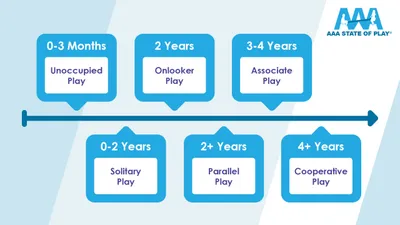
Parten's framework describes six stages, and understanding the full sequence helps you recognize where a child is:
Unoccupied play involves exploring movement and materials without any defined objective.
Solitary play has children playing independently, building motor and cognitive skills on their own.
Onlooker play means watching others play without joining in, which is observation rather than disengagement.
Parallel play puts children alongside each other with similar materials and limited interaction.
Associative play brings social engagement during play without structured goals or roles.
Cooperative play has children working toward shared goals, setting rules, and solving problems together.
The stages roughly track age, moving from infancy through the preschool years into the early elementary grades. They aren't a strict schedule, and a child who spends a lot of time in solitary play at four isn't behind. Designing a space that supports several stages at once serves a mixed-age group better than optimizing for any single one.
Support every stage of play with equipment from AAA State of Play
AAA State of Play carries commercial-grade early childhood play equipment for daycare centers, preschools, churches, and schools, including sand play, dramatic play, trikes, and classroom materials that support associative play and the stages around it. Our team can help you build a space that fits your age groups and your budget. Contact us today!