
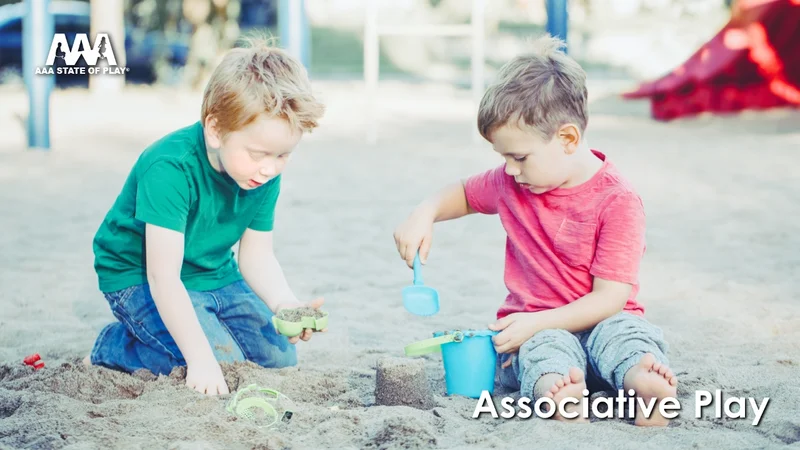
In early childhood, associative play is an important stage of play that supports social interaction and communication. As children grow and begin engaging more with peers, associative play helps them practice interacting with others in informal, unstructured ways that contribute to healthy development.
What Is Associative Play?
Associative play is a stage of play in which children interact with one another during play without established rules, roles, or shared goals. While children may communicate, share materials, or influence each other’s activities, their play remains loosely organized and individually focused.
This stage reflects growing social awareness. Children begin recognizing peers as part of their play experience rather than playing entirely independently, which helps prepare them for more structured group activities later on.
Benefits of Associative Play
Associative play supports multiple areas of early childhood development, including:
Social interaction: Children practice initiating conversations, responding to peers, and navigating social exchanges.
Language development: Informal play encourages conversation, storytelling, and the use of new vocabulary.
Problem-solving skills: Children experiment with choices and adapt their behavior based on peer interaction.
Emotional development: Associative play helps children build confidence in group settings and become more comfortable interacting with others.
Preparation for cooperative play: Skills practiced during associative play lay the foundation for teamwork, shared goals, and rule-based play.
Examples of Associative Play
Associative play often appears informal, but meaningful social interaction is present. Common examples include:
Children building with blocks while talking about what they are creating.
A group of children riding tricycles together without organized rules.
Children playing with sand or water while sharing tools and ideas.
Preschoolers working on individual art projects at the same table and commenting on one another’s work.
In each example, children remain focused on their own activity while engaging socially with peers.
Encouraging Associative Play
Associative play is supported by giving children opportunities to interact with peers during open-ended activities. Shared materials such as art supplies or building toys allow children to play independently while engaging socially.
Adults can encourage this stage by showing interest in children’s activities, asking simple questions, and providing enough shared resources to support informal interaction and sharing.
The Other Stages of Play
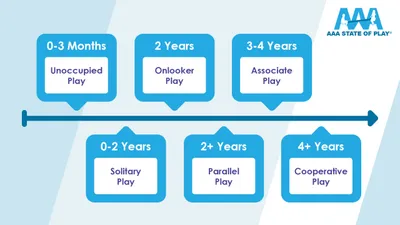
Unoccupied Play: Children explore movement and materials without a defined play objective.
Solitary Play: Children play independently, developing motor and cognitive skills.
Onlooker Play: Children observe others playing without participating directly.
Parallel Play: Children play alongside others using similar materials with limited interaction.
Associative Play: Children engage socially during play without structured goals or roles.
Cooperative Play: Children work together toward shared goals, establish rules, and collaborate to solve problems.