

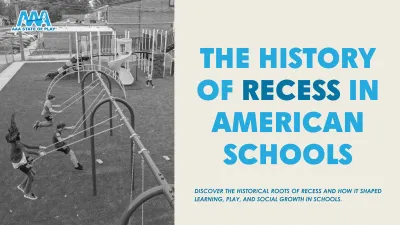
If children could major in any subject, “recess” would likely be at the top of the class roster. For generations, recess has been the favorite “subject,” the one where imagination meets movement, and friendships are built as fast as jungle gyms are climbed. But behind every swing set and four-square game lies a fascinating story—one that mirrors the evolution of American education itself.
At AAA State of Play, we’ve spent years helping schools create spaces where recess thrives, giving us a front-row seat to its past, present, and future. To understand more where we’re going, it’s worth looking back at how recess in American schools began, and why it remains more vital than ever.
The Early Roots: When Play Met Pedagogy
In the 19th century, American schools were often rigid places, emphasizing order, memorization, and moral instruction. Children sat at wooden desks for long hours, reciting lessons and writing on slate boards. The concept of “free time” within education was almost radical.
Yet, education reformers like Horace Mann and Friedrich Froebel (the inventor of kindergarten) argued that play was not the opposite of learning but a powerful complement to it. As they began to emphasize the importance of physical and mental balance, schools started to carve out moments for unstructured play.
By the mid-1800s, playgrounds were catching on in European cities as safe, supervised areas for children to exercise and socialize. The idea reached the United States around the 1880s, largely through the playground movement, which sought to create structured areas for safe play in growing urban environments. Early educators quickly noticed a pattern: when children had a chance to play freely, they returned to class calmer, more attentive, and ready to learn.
Recess, in other words, wasn’t a distraction. It was a tool.
From the Playground Movement to Public Policy
By the late 19th and early 20th centuries, the playground movement gained national traction. Reformers like Joseph Lee—often called the “father of the playground movement”—advocated for play as a right of every child, not just a privilege. His writing and activism linked play to moral growth, health, and social responsibility.
Schools began to integrate playgrounds into their designs, often through local government partnerships and philanthropic efforts. Cities like Boston, Chicago, and New York became early leaders in installing schoolyard equipment. Swings, slides, and merry-go-rounds started appearing across the nation, serving not just as outlets for energy but as arenas for developing cooperation and creativity.
The Golden Age of Recess: Post–World War II to the 1980s
After World War II, the baby boom brought millions of children into schools, and America responded by expanding educational infrastructure on an unprecedented scale. The 1950s and 1960s saw the rise of large, well-equipped school playgrounds, influenced by suburban growth and new community planning ideals.
Recess was considered essential to a well-rounded day. It promoted fitness, social-emotional development, and imaginative play: all key elements in nurturing well-adjusted citizens. The typical school day included at least one, and often two, periods of outdoor play. Communities took pride in their schoolyards, which reflected local commitment to child welfare.
However, by the 1970s and 1980s, concerns began to grow about playground safety. Early equipment, often built from steel and concrete, could pose hazards. As playgrounds aged and maintenance lagged, school districts began rethinking standards. The conversation started to shift toward how to keep children safe without sacrificing the joy and freedom that define play.
This transition set the stage for modern playground innovation—something AAA State of Play has proudly championed for years.
The Recess Revolution: Safety, Structure, and Standards
The 1990s brought a wave of reform in playground safety and design. National standards from organizations like the Consumer Product Safety Commission (CPSC) and American Society for Testing and Materials (ASTM) International introduced new expectations for durability, surfacing, and inclusivity. Schools upgraded old equipment with safer materials like high-density polyethylene and powder-coated steel.
At the same time, educational theories such as Howard Gardner’s multiple intelligences and new research on play reinforced the importance of physical and social activity in cognitive growth. Recess wasn’t just “fun time” anymore—educators and psychologists championed it as central to learning development.
But paradoxically, the 1980s and early 2000s also saw a decline in recess minutes. As academic standards tightened under initiatives like No Child Left Behind, many schools shortened or eliminated recess altogether in favor of extended classroom instruction.
The logic was straightforward but misguided: more time in class meant better academic outcomes. Yet studies soon proved the opposite: reduced physical activity led to decreased attention spans, higher stress levels, and lower overall performance. This also sparked a new movement led by parents, educators, and child development experts to protect recess.
Today, thanks to decades of advocacy, recess is once again recognized as vital to physical health, emotional well-being, and academic performance. Studies continue to show that children who play are children who learn better, cooperate more effectively, and experience lower stress.
Modern Recess: Innovation, Inclusion, and Intentional Design
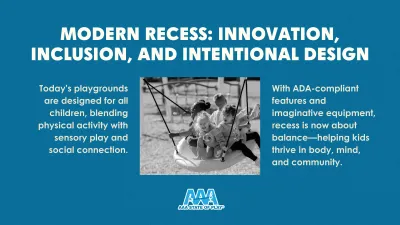
In today’s schools, the recess yard looks very different from the one our grandparents knew, and that’s a good thing. Playgrounds have become more inclusive, accessible, and imaginative than ever.
Modern equipment emphasizes not only physical activity but also sensory engagement and social connection. You’ll find interactive musical elements, climbing nets designed for teamwork, and ADA-compliant features that ensure every child, regardless of ability, can play safely and meaningfully.
AAA State of Play has played a leading role in this transformation. Through expert consultation, durable and imaginative design, and commitment to safety, we partner with schools across the nation to craft play spaces that truly work for teachers, for administrators, and above all, for kids.
Because recess isn’t just about taking a break. It’s about building balance between body and mind, learning and living, and structure and freedom.
Looking Ahead: The Future of Recess in America with AAA State of Play
The story of recess in American schools is ultimately the story of how we value childhood itself. From dusty schoolyards to inclusive modern playgrounds, recess has endured because it taps into something fundamental: the need to move, to connect, and to imagine.
At AAA State of Play, we believe that investing in play is investing in the future. Our team of experts designs playground solutions that balance fun, safety, and developmental growth, ensuring recess remains an essential part of every school day.
Tap us for more information, and let’s craft a recess experience that supports learning, growth, and joyful play for generations to come. After all, the history of recess isn’t just a story of play. It’s a story of progress, and we’re proud to keep it going, one playground at a time.
Explore the Building Blocks of Better Playgrounds with These Reads
- Explore more about history, and this time with children’s favorite places:
Learn the History of Playgrounds and Playground Equipment | AAA State of Play
- Discover unique playground designs outside the country:
The Most Unusual Playgrounds Around the World | AAA State of Play
- Because children’s play equipment at school is not one-size-fits-all:
Designing School Playgrounds for Multiple Age Groups: Zoning and Equipment Tips | AAA State of Play
- For more tips on improving children’s confidence through the play areas:
A Guide to Building Confidence in Children on the Playground | AAA State of Play
- Because elementary school children deserve the best play equipment:
What Playground Equipment Is Best for Elementary School Children? | AAA State of Play


