

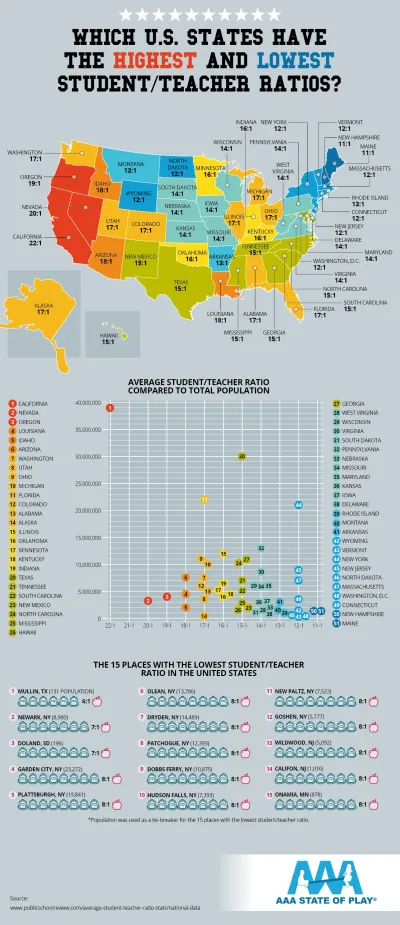
The average public school student/teacher ratio in the United States is approximately 15 students to one teacher, according to Public School Review. Why is student/teacher ratio important? It’s believed that smaller classes allow teachers to spend more time focusing on the needs of individual students, reduce the amount of class time needed to deal with disruptions, improve working conditions for both teachers and staff, and overall contribute to a more comprehensive and meaningful learning environment. Small class sizes are especially important for early education, special education, and students from disadvantaged backgrounds. Smaller classroom sizes also correlate with higher teacher satisfaction! The team at AAAStateofPlay has created a guide to the average student/teacher ratio by state to highlight where classroom size reform may be needed and to provide insights into each state’s educational system to help parents, teachers, and caregivers make informed decisions:
Embed this image on your site:
What State Has the Lowest Student/Teacher Ratio?
Maine and New Hampshire are tied for the lowest student/teacher ratio in the United States, with an average of 11 students per teacher. In comparison, the U.S. average student/teacher ratio is 15:1.
Here are the top 20 U.S. states with the lowest student/teacher ratios:
- Maine — 11:1
- New Hampshire — 11:1
- Connecticut — 12:1
- Washington, D.C. — 12:1
- Massachusetts — 12:1
- North Dakota — 12:1
- New Jersey — 12:1
- New York — 12:1
- Vermont — 12:1
- Wyoming — 12:1
- Arkansas — 13:1
- Montana — 13:1
- Rhode Island — 13:1
- Delaware — 14:1
- Iowa — 14:1
- Kansas — 14:1
- Maryland — 14:1
- Missouri — 14:1
- Nebraska — 14:1
- Pennsylvania — 14:1
What State Has the Highest Student/Teacher Ratio?
The state with the highest student/teacher ratio is California, with an average of 22 students per teacher.
Here are the top 20 states with the highest student/teacher ratios:
- California — 22:1
- Nevada — 20:1
- Oregon — 19:1
- Louisiana — 18:1
- Idaho — 18:1
- Arizona — 18:1
- Washington — 17:1
- Utah — 17:1
- Ohio — 17:1
- Michigan — 17:1
- Florida — 17:1
- Colorado — 17:1
- Alabama — 17:1
- Alaska — 17:1
- Illinois — 17:1
- Oklahoma — 16:1
- Minnesota — 16:1
- Kentucky — 16:1
- Indiana — 16:1
- Texas — 15:1
What Town Has the Lowest Student-Teacher Ratio?
The town with the lowest student/teacher ratio is Mullin, Texas, which has an average student/teacher ratio of six students to one teacher. The town with the highest student/teacher ratio is Maumee, Ohio, with an average of 41 students per teacher.
What Are the Benefits of Having a Smaller Class Size?
A few of the benefits of a lower student/teacher ratio include improved test scores, a lower dropout rate, and higher graduation rates. The Student Teacher Achievement Ratio study, conducted in Tennessee during the late 1980s, discovered that a large reduction in class size resulted in an increase in student achievement by “an amount equivalent to about 3 additional months of schooling four years later.”
According to the OECD, or the Organization for Economic Co-Operation and Development, “Overall, evidence on the effects of reduced class size on student performance is weak. Also, there is no consensus on what the best ratio of students to teachers should be at different students’ ages, but there is wide agreement that younger children need more time and interaction with teachers for a quality education, supporting a lower ratio of students per teacher in early education. There is also some evidence showing that smaller classes may benefit students from disadvantaged backgrounds. Research also indicates a positive association of smaller class size and higher teacher satisfaction.”
Additionally, smaller average classroom sizes around the world seem to have some correlation with academic achievement. For example, Norway’s average student/teacher ratio is 10.5 to 1 for elementary school and 10.2 to 1 for secondary school. Norway is renowned for the quality of education that it provides for its students. While there are many factors contributing to it, such as plenty of play and exercise opportunities, it is likely that a lower student/teacher ratio plays a valuable role.
Which U.S. States Have the Highest and Lowest Student/Teacher Ratios?
- California — 22:1
- Nevada — 20:1
- Oregon — 19:1
- Louisiana — 18:1
- Idaho — 18:1
- Arizona — 18:1
- Washington — 17:1
- Utah — 17:1
- Ohio — 17:1
- Michigan — 17:1
- Florida — 17:1
- Colorado — 17:1
- Alabama — 17:1
- Alaska — 17:1
- Illinois – 17:1
- Oklahoma — 16:1
- Minnesota — 16:1
- Kentucky — 16:1
- Indiana — 16:1
- Texas — 15:1
- Tennessee — 15:1
- South Carolina — 15:1
- New Mexico — 15:1
- North Carolina — 15:1
- Mississippi — 15:1
- Hawaii — 15:1
- Georgia — 15:1
- West Virginia — 14:1
- Wisconsin — 14:1
- Virginia — 14:1
- South Dakota — 14:1
- Pennsylvania — 14:1
- Nebraska — 14:1
- Missouri — 14:1
- Maryland — 14:1
- Kansas — 14:1
- Iowa — 14:1
- Delaware — 14:1
- Rhode Island — 13:1
- Montana — 13:1
- Arkansas — 13:1
- Wyoming — 12:1
- Vermont — 12:1
- New York — 12:1
- New Jersey — 12:1
- North Dakota — 12:1
- Massachusetts — 12:1
- Washington, D.C. — 12:1
- Connecticut — 12:1
- New Hampshire — 11:1
- Maine — 11:1
Top 10 Towns With the Lowest Student/Teacher Ratios
1. Mullin, TX (131 population)
6:1
2. Newark, NY (8,980)
7:1
3. Doland, SD (196)
7:1
4. Onamia, MN (878)
8:1
5. Califon, NJ (1,010)
8:1
6. Wildwood, NJ (5,092)
8:1
7. Dobbs Ferry, NY (10,875)
8:1
8. Dryden, NY (14,489)
8:1
9. Garden City, NY (23,272)
8:1
10. Goshen, NY (5,777)
8:1
11. Hudson Falls, NY (7,393)
8:1
12. New Paltz, NY (7,523)
8:1
13. Olean, NY (13,786)
8:1
14. Patchogue, NY (12,393)
8:1
15. Plattsburgh, NY (19,841)
8:1
Related: Elementary school playground equipment
Find more about the author: Kim Hart