

Most playground problems show up 12 to 36 months after installation, not on opening day, because surfacing settles, equipment shifts, and drainage patterns change once the site is in real use. Installation is the last moment when conditions are predictable, and corrections are cheap. Everything after that involves working around public use, a closed budget, and higher scrutiny.
This guide covers why early success is misleading, how wear actually develops, why inspection findings lag the decisions that caused them, and what a monitoring routine should look like.
Why don't playground problems appear at installation?
Because installation is measured under ideal conditions. The surfacing is at specified depth, footings are fresh, grades are exactly as drawn, and no child has used the equipment yet. A site inspected the week it opens is being tested at its best possible moment.
Real conditions arrive immediately after. Wear starts with the first class of students, weather begins acting on the base and the finishes, and traffic concentrates in the places kids actually run. None of that is visible at handoff, which is why passing an installation inspection tells you the site was built correctly and almost nothing about whether it will stay compliant.
The gap between those two things is where most problems live. A playground can be built exactly to specification and still fall out of compliance within two years if nobody is measuring what changed.
Why early success is misleading
A playground that performs well in its first months creates confidence that isn't always warranted. Four assumptions tend to go unchallenged during that period:
Surfacing will stay at required depth, when loose-fill materials compact and displace steadily under traffic.
Equipment spacing won't change, when posts can shift slightly and swing hangers wear.
Drainage patterns will stay stable, when settling and sediment gradually redirect water.
Maintenance needs will be minimal, which is usually true for the first year and rarely true after that.
None of these get tested until conditions change or an inspection happens. That's the core problem: the failure mode is silent, and the site looks fine right up until somebody measures it.
Wear Does Not Happen Evenly
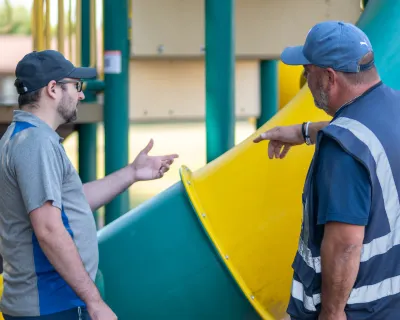
Playground wear concentrates rather than spreading. Slide exits, swing landings, and the paths between popular components compact fastest, so the surfacing under the highest-risk fall zones is often the thinnest on site. That's the exact inversion of what you want.
Weather exposure varies across a site too. The sunny half of a playground ages differently than the shaded half, and a low corner that holds water will deteriorate on its own schedule. Drainage problems in particular develop gradually enough that staff walking the site daily stop noticing them.
The incremental nature is what makes this hard. A quarter inch of surfacing loss per month is invisible to the eye and adds up to a failed depth check inside a year. These conditions become visible only when measured, inspected, or questioned.
Inspection Issues Are Often Lagging Indicators
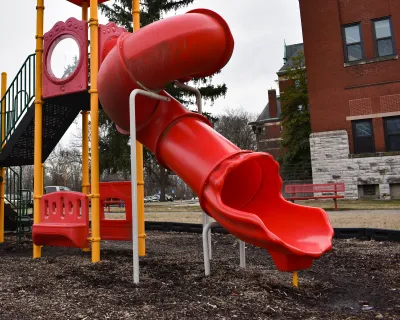
When an inspector flags a surfacing deficiency, a spacing problem, or an accessibility issue, the root cause is almost never a single failure. It's usually a pattern of deferred monitoring stretching back months.
Findings tend to surface at predictable points:
After surfacing has settled or eroded below the minimum depth required for the equipment's fall height.
When equipment movement affects use zones, since the Consumer Product Safety Commission (CPSC) calls for at least 6 feet of clearance from stationary equipment.
When drainage or grading has changed enough to leave standing water or expose a footing.
When documentation can't account for site conditions, leaving no record of when something was last checked.
By the time an issue reaches an inspection report, the correction is more disruptive and more expensive than it would have been at any earlier point. Loose-fill surfacing generally needs 12 inches of installed depth, and ASTM International standard ASTM F1292 sets the impact attenuation requirement, so topping up playground surfacing on a schedule costs far less than a corrective action under an open finding.
Documentation Gaps Become Visible Later
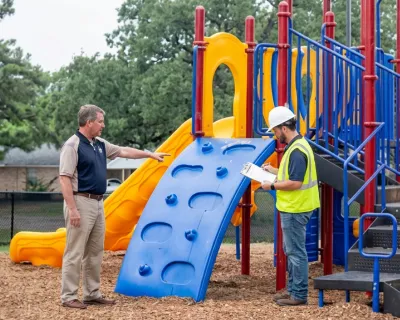
Documentation rarely matters until it suddenly matters a great deal. Maintenance logs, inspection reports, and corrective action records feel secondary during normal operation, and that's exactly when they stop getting filled in.
Records become critical in four situations:
An inspection raises a question about when a condition first appeared or was last addressed.
A complaint is filed by a parent, a staff member, or a community group.
An incident occurs on the equipment and the site's condition history comes into question.
A review is conducted months or years after installation, often by someone with no involvement in the original project.
Missing records create exposure even when the physical conditions are acceptable. A site in good shape with no maintenance log is harder to defend than a site with a documented history of monitoring and correction, because the log is the only evidence that anyone was paying attention.
Why Reactive Corrections Are More Difficult
Fixing something after installation means working inside limits that didn't exist during planning. Four of them show up consistently:
Ongoing public use means closures, partial access, and scheduling around when the site is empty.
Closed budget cycles push corrections into the next fiscal year or force them out of a maintenance line never sized for them.
Increased visibility means the work happens in front of the community rather than behind a construction fence.
Limited flexibility on layout and materials, since you're now matching existing conditions instead of specifying fresh.
A layout adjustment that costs a redline during design becomes a demolition and reinstallation once the equipment is anchored and the surfacing is poured. That cost curve is the practical argument for treating installation as a starting point.
Building a post-installation monitoring routine
The fix is unglamorous: measure the things that change, on a schedule, and write down what you find. A workable routine has three tiers.
Frequent visual checks happen weekly or after storms, looking for displaced surfacing, standing water, vandalism, and loose hardware.
Detailed measured inspections happen quarterly, with actual depth readings at slide exits and swing landings, clearance checks around equipment, and photos.
Annual audits by a Certified Playground Safety Inspector give you an outside read against current CPSC guidance and ASTM standards, plus a document you can hand a reviewer.
Rake and replenish loose fill as a routine task rather than a response. Compaction is continuous, so scheduled raking keeps depth and accessibility performance closer to specification than any amount of periodic emergency topping up. Well-maintained playground borders also matter more than they look, since they're what keeps loose fill inside the use zones in the first place.
Post the rules and the inspection contact where users can see them. Safety signs with age guidance and a reporting number turn site users into an informal monitoring layer and demonstrate that the operator communicated known conditions.
What This Means for Public Agencies
Success shouldn't be measured on opening day. Agencies that treat installation as the beginning of responsibility rather than the end are better positioned to catch issues before they escalate, stay inspection-ready, address wear proactively, and defend decisions with records.
The playgrounds that hold up over 10 or 15 years aren't the ones that looked best at the ribbon cutting. They're the ones that got measured quarterly and documented consistently. Problems don't emerge suddenly; they emerge gradually as early decisions get tested by time, and the agencies that plan for that phase spend far less than the ones that discover it.
Plan and maintain your playground with AAA State of Play
AAA State of Play works with parks departments, schools, and municipalities on playground projects from specification through installation planning, including surfacing, borders, and signage sized to your site. Our specialists can help you build a configuration that stays compliant well past opening day. Request a free quote today!


