
A playground is a 15- to 20-year asset that gets funded like a 90-day project, and that gap is where public risk accumulates. Emergency rooms treat roughly 200,000 playground injuries a year in the United States, and a large share trace back to conditions that developed after installation rather than defects at delivery.
This guide is for parks and recreation directors, school facilities staff, municipal risk managers, and HOA boards who approve playground spending. You'll get the lifecycle costs that rarely appear on a purchase order, why surfacing drives the most exposure, what inspectors actually look at as a site ages, and how to budget so corrective work isn't an emergency.
Installation Cost Is Not the Same as Lifecycle Cost
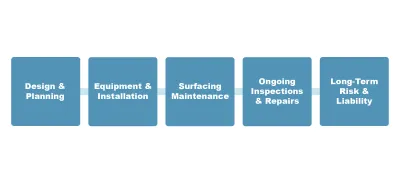
The purchase order that authorizes installation typically covers 60% to 70% of what the playground will cost your department over its service life. The rest arrives in pieces, spread across years, in budgets that were never asked to plan for it.
Lifecycle cost on a public playground includes five recurring line items:
Surfacing maintenance and replenishment is the largest ongoing expense. Loose-fill material has to be raked, redistributed, and topped off to hold its tested depth, often several times a year in high-traffic zones.
Component replacement follows wear, not warranty terms. Swing chains, bearings, slide beds, and hardware wear on their own schedule. Warranties commonly run 1 to 10 years by component, with up to 100 years on structural posts, so most of what needs replacing first is the part with the shortest coverage.
Labor is a standing cost, not a project cost. Someone has to walk the site, document what they found, and act on it. That time belongs in a staffing plan.
Inspection readiness requires budget, not just intent. Findings that need correction inside 30 days need money already available.
Contingency protects the schedule. Without a reserve, a single failed component can close a play area for a season while a purchase moves through procurement.
None of these are optional for a playground in active public use. When they're left out of planning, the department ends up making decisions reactively, under public scrutiny, with fewer options and less time.
Why Surfacing Creates the Greatest Long-Term Exposure
Surfacing is the single biggest source of preventable injury exposure on an aging playground, because it's the one safety feature that degrades continuously while looking fine. The Consumer Product Safety Commission (CPSC) calls for a minimum of 12 inches of loose-fill material, maintained across the full 6-foot use zone around equipment.
Loose fill doesn't stay where you put it. Children kick it out of landing areas, weather compacts it, and erosion moves it downhill, and a bed that measures 12 inches in spring can measure 6 inches under a swing by late summer with no visible change from a distance.
That matters because impact attenuation is tested, not assumed. Surfacing is evaluated against ASTM F1292 for fall height performance and ASTM F1951 for accessibility, and both depend on depth being maintained rather than installed once. Replacing depleted playground surfacing and keeping a solid playground border to contain the material is far cheaper than the corrective work that follows a failed inspection.
Deferred surfacing maintenance produces a predictable chain of consequences:
Fall injuries get more likely and more severe as effective critical fall height drops below what the equipment requires.
Inspection outcomes become unpredictable, which makes planning and reporting harder.
Liability exposure rises when documentation shows a known condition went unaddressed.
Corrective action gets more disruptive. Restoring a badly depleted area often means closing the playground rather than topping it off during a normal work order.
Inspection Readiness Is an Ongoing Obligation
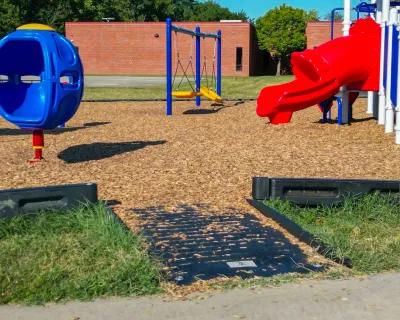
Passing inspection on installation day says nothing about compliance in year seven. A Certified Playground Safety Inspector evaluates current site conditions against ASTM F1487 and the CPSC Public Playground Safety Handbook, and most of what they measure changes over time.
Recurring inspection findings on public sites cluster around four things:
Surfacing depth and consistency across the use zone, not just at the center.
Equipment wear and spacing, including entrapment openings that must stay under 3.5 inches or over 9 inches, plus protrusions and worn hardware.
Drainage and site stability, since standing water displaces loose fill and undermines footings.
Maintenance documentation, which is often the finding that carries the most weight after an incident.
Agencies that budgeted only for installation usually can't act on findings quickly, so corrections queue up. That backlog is what turns a routine audit or a post-incident review into a problem, because the record shows the condition was identified before anyone got hurt.
Public Risk Grows Quietly When Planning Stops Early
Public playgrounds carry shared accountability and constant visibility, so failures rarely stay small. A frayed swing hanger is a $40 part and a 20-minute repair on a maintenance schedule, and it's a closed play area and a council meeting agenda item without one.
When long-term planning is skipped, four things tend to follow: minor issues become visible failures, deferred maintenance turns into reputational risk, unplanned repairs strain department budgets, and corrective spending gets harder to justify publicly after the fact. Planning for these costs at the front end is consistently less expensive than explaining them later.
What long-term asset management looks like in practice
Treating a playground as a managed asset comes down to putting three things in writing before installation. Departments that do this hold inspection readiness with far less scrambling.
Set an annual maintenance line at 1% to 3% of installed cost. It funds surfacing replenishment, hardware, and labor without a special request each time.
Schedule inspections on a fixed cycle. Low-frequency visual checks weekly, detailed inspections quarterly, and a comprehensive audit annually is a common structure for public sites. Log every one, including the visits where nothing was wrong.
Plan replacement by component, not by structure. Surfacing, swing seats, and moving parts turn over on much shorter cycles than playground structures themselves, so budgeting them separately keeps the whole system from aging out at once.
Post and maintain site signage. Clear safety signs listing the intended age range, supervision expectations, and a number for reporting problems give the public a way to flag issues before an inspector does.
Age isn't the variable that determines whether a playground is safe. A well-maintained 12-year-old site regularly outperforms a neglected 3-year-old one on the exact measures an inspector records.
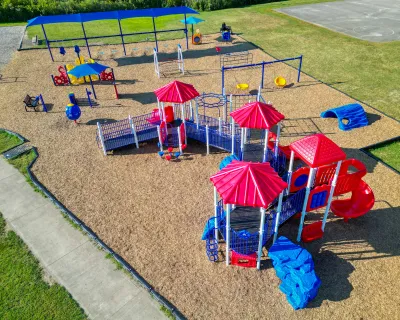
Plan a playground built to last with AAA State of Play
The strongest playground projects are scoped for the years after installation, not just the day of it. AAA State of Play works with parks departments, schools, municipalities, and HOAs on equipment, surfacing, and site amenities chosen with maintenance and inspection realities in mind. Request a free quote today!