

Rubber mulch is the better choice for high-traffic playgrounds because it retains its shock-absorbing properties for 10 years or more without decomposing, while engineered wood fiber (EWF) costs less upfront and delivers a natural look, at the cost of ongoing raking and re-topping. Both are loose fill surfacing materials and need at least 12 inches of depth under playground equipment. Both also compress by at least 25% over time, so the real difference is what happens after year one.
If you're specifying playground surfacing for a park, school, or childcare site, this comparison covers impact absorption, maintenance requirements, accessibility, and lifetime cost for each material. You'll get the standards and the inch figures you need to defend the choice to a board or a budget committee.
How do rubber mulch and engineered wood fiber compare?
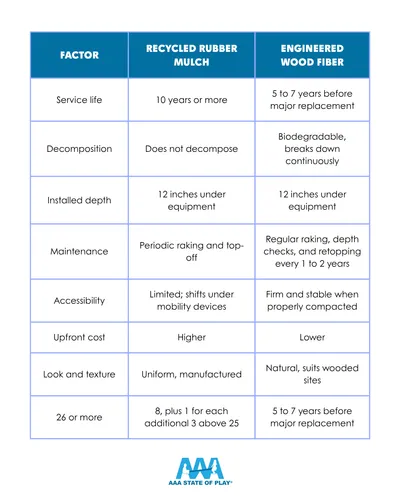
Both materials sit in the loose fill category rather than the unitary playground surfacing category, which matters more than the differences between them. Neither one is a seamless solid installation, so both need containment, depth monitoring, and replenishment in a way that poured-in-place rubber and rubber tiles don't.
Which material absorbs impact better?
Both meet the standard, but rubber holds its performance longer. The Consumer Product Safety Commission (CPSC) recommends at least 12 inches of shock-absorbing surfacing under play equipment, and impact attenuation is measured by ASTM F1292, which assigns each material a critical height rating: the maximum fall height at which it keeps impact forces below the injury threshold.
The difference is durability of protection, not the initial test result. Recycled rubber mulch retains its shock absorption over years because the material doesn't break down, while engineered wood fiber loses cushioning as the fiber decomposes and compacts. That matters because falls account for nearly 70% of playground injuries, and a surface protects only at the depth and condition it actually holds on any given day.
Which needs less maintenance?
Engineered wood fiber needs noticeably more attention. It requires regular inspections for depth and hazards, raking to keep the surface even, and re-topping every one to two years as the material biodegrades. Rubber mulch still compresses and still migrates out of high-traffic areas, but it doesn't rot, so replenishment comes less often.
Both share the same compaction problem, and it's the one people underestimate:
Loose fill compresses at least 25% over time, which means a surface installed at exactly 12 inches drops below spec within its first busy season.
Both need proper drainage underneath, since standing water accelerates decomposition in wood fiber and degrades the base under either material.
Both need a containment edge. A playground border is what keeps loose fill inside the use zone instead of spreading into surrounding turf.
Which is more accessible for mobility devices?
Engineered wood fiber wins this one, which surprises people. When properly installed and compacted, EWF forms a firm, stable surface that supports wheelchairs and strollers, and it's the loose fill material most often specified where Americans with Disabilities Act (ADA) guidelines apply. Accessibility standards require a surface to be firm and stable, and loose fill rubber nuggets shift under a caster wheel in a way compacted fiber doesn't.
The caveat is that both materials can fail over time. Loose fill may compact unevenly and become difficult to navigate, and a thinned transition at the edge of an accessible route stops working entirely. Any site serious about accessible and inclusive play should weigh a unitary surface before committing to either loose fill option.
How do the costs compare over the life of the surface?
Engineered wood fiber is the cost-effective pick on a tight budget and the more expensive one across a full budget cycle. The upfront gap is real, often substantial on a large play area, but EWF's shorter service life and heavier maintenance load close it and then reverse it over 10 years.
Rubber mulch flips that math. It costs more per square foot installed and less in recurring labor, material, and replacement, so a site with limited grounds staff usually comes out ahead paying once. A facility funding a project through a single grant cycle sometimes has no choice but to start with wood fiber, which is a reasonable decision as long as the depth checks actually happen.
Where does each material fit best?
Match the material to the site rather than picking a favorite:
Choose rubber mulch for high-traffic areas like busy municipal parks and elementary schools, where displacement and decomposition would otherwise drive constant upkeep.
Choose engineered wood fiber for nature-themed and wooded sites where the natural look matters, and for projects where the accessible route has to cross loose fill.
Consider shade over dark rubber in hot climates. Dark rubber surfaces absorb heat, so shade structures belong in the plan on any exposed southern site.
Some playground flooring materials to rule out either way: pea gravel drains well but cushions poorly and presents a choking hazard for younger children, and artificial turf or natural grass carries no critical height rating at all.
When should you skip loose fill entirely?
Unitary surfacing is worth the premium when maintenance capacity is the binding constraint. Poured-in-place (PIP) rubber, made from shredded rubber bound with a polyurethane binder, requires very little maintenance and can be engineered to accommodate fall heights up to 16 ft, which no loose fill material approaches. Rubber tiles are similarly durable and low maintenance, and synthetic turf works when it's installed over a proper shock-absorbing pad.
The tradeoff is upfront cost and a different aesthetic. A seamless surface reads as more finished and less natural, and it locks in your fall height at installation, so confirm the critical height rating against the tallest deck on your play structures before you commit. For most high-traffic public sites, that certainty is exactly what makes it worth pricing.
Compare Playground Surfacing Materials With AAA State of Play
The right playground surface answer usually comes down to three numbers: daily traffic, available maintenance hours, and the fall height you have to cover. AAA State of Play works through that comparison with parks departments, school districts, and childcare centers all the time. We're glad to help you decide the right playground safety surfacing choice for your site whenever it's useful.