
Key Findings
- The author argues that $40,000 and $400,000 playground projects take around the same investment of time and effort from a salesperson.
- Compensation structures, quotas, margins, and territories favor larger projects; this is not a matter of individual salespeople being greedy.
- Buyers can ask about typical project size, who creates drawings and when, and a written closeout timeline.
- Good service shouldn’t depend on the size of the quote.
Imagine you’re a small-town school administrator with around $40,000 of budget to build a new playground. In order to get the best bang for your buck, you do your due diligence by shopping around three different sellers. The first two never get back to you, while the third takes two weeks to send you an actual quote, then goes MIA after you give them the thumbs-up.
At this point, it’s natural to wonder why you keep getting ghosted by people who allegedly want your money.
Was it something you said? Was it your location or the timeline you proposed? In reality, it was none of those things, but there’s a good chance no one will ever tell you this.

Same steps. Any size project.
Something no one in our industry ever seems to say aloud is that just about every playground project, whether it’s valued at $40,000 or $400,000, takes around the same investment of time and effort on the part of the salesperson. From site visits to 3D render creation to final paperwork, every project, regardless of size and scope, has the same basic steps involved.
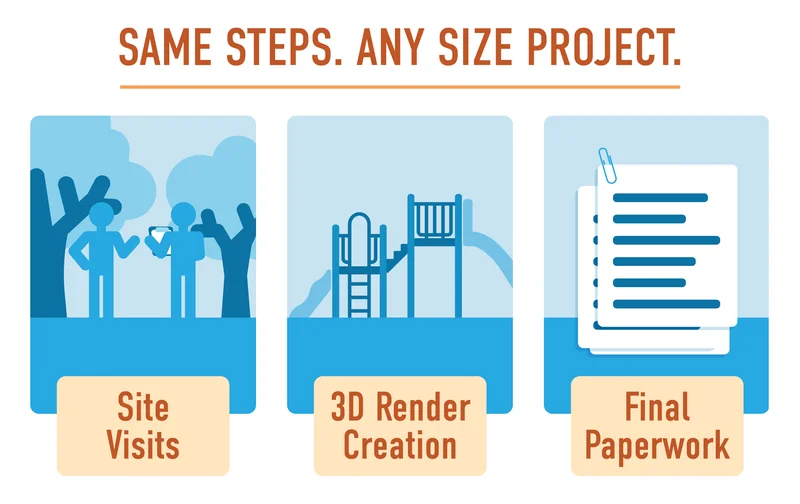
- Site visits
- 3D render creation
- Final paperwork
So, at the end of the day, the biggest blocker for smaller playground projects is that higher-dollar projects require a similar time investment, yet result in a greater commission for salespeople. This creates an incentive for them to focus on higher-dollar projects, sometimes at the expense of ones on the lower end.
Sales structure, not greed
To be clear, this isn’t a matter of salespeople being greedy. Just about everyone answers to someone above them, and in this case, playground salespeople have been given a territory with target quotas and margins, and lower-dollar projects tend not to align with meeting either of those.
Chances are there wasn’t even an explicit order from the sales director saying “Disregard all customers under x amount of dollars.” In fact, there doesn’t need to have been one. All of what I’ve described is a sales system working exactly as intended. As a $40k buyer, you are told, either explicitly or implicitly, that your budget is too small to work with, despite that same company selling spring riders and benches for $2k a pop.
In reality, a salesperson’s inability to make a $40k budget work isn’t a function of the equipment you’re buying; rather, it comes down to the compensation plan that salespeople are given, and how it inherently boxes out smaller-time buyers.
Sales goals
- Quotas
- Margins
- Territories
- High-value projects

Three questions to ask your salesperson
So, how can you navigate the playground sales landscape without getting ghosted? One of the best ways to get a good idea of who you’re working with is to ask your salesperson the following:
- What’s your typical project size?
- Who creates the drawings, and when does that happen?
- What’s your closeout timeline, and can I get it in writing?
These aren’t “gotcha” questions. Any competent salesperson should be able to get you a satisfactory answer to each of these. And, if they can’t, that’s probably a sign that your project will be deprioritized.
So, when you first call or email a playground company, try to be a discerning customer. Not just as it relates to the equipment you want to buy, but the process by which that equipment will be purchased and installed.
Theory vs. Practice
Theory
- Playground companies will be happy to take your money regardless of your project size.
- If a salesperson doesn’t get back to you about your relatively smaller order, it’s because they’re just trying to line their pockets with bigger commissions.
Practice
- Orders under $40,000 will eventually get done, but they tend to be put on the backburner in favor of larger-dollar orders.
- Playground salespeople operate downstream of a sales structure with minimum quotas and margins, all of which favors bigger quotes over smaller ones.
- For salespeople, meeting quotas and margins is a big part of how they show that they’re doing an effective job.
How to Cite This Chapter
Breedlove, Nicolas. “Why Small Budgets Get Ghosted.” State of Play 2026, Chapter 7, AAA State of Play, October 2026. https://www.aaastateofplay.com/state-of-play/why-small-budgets-get-ghosted/