

A school should place a new playground where it will serve the most people for the most hours. For most schools, that default is behind the building, out of sight from the street, accessible only to students during school hours. For some schools, especially those in communities without nearby parks or green space, the better decision is to place the playground at the front of the school where the surrounding neighborhood can see and use it during evenings and weekends.
South View Elementary in Muncie, Indiana, made the front-facing decision in 2025, and the result turned a $226,000 playground into a neighborhood community hub and valuable outdoor space. Here is how that school playground placement decision worked, why it is unusual, and when it is the right call.
The Hot Take
90 percent of school playgrounds are hidden behind the building, where nobody outside the school ever sees them. That is not a design choice. That is the absence of one. Nobody decided to put it there. Nobody fought for that location. The playground ended up in the back because nobody in the planning meeting asked where it should go. The back of the building is the default. The default is not a decision. The default is what happens when nobody makes one.
The Framework: The Community Hub Principle
A playground in the back serves the school. A playground in the front serves the neighborhood. Same playground equipment, same budget, completely different function and play value. If your community already has parks, the back is fine. If your community does not have parks, the back is a missed opportunity the size of the entire build.
Why Most School Playgrounds Are in the Back
The default location for a school playground is behind the building. There are reasons for this, and most of them are practical. Site planning for schools typically treats the front of the building as the formal entrance, with parking, drop-off, and main access routes. The back of the building tends to have open space, better separation from traffic, and simpler supervision lines during recess.
The back is the default because nobody has to fight for it. It is not necessarily the right location. It is just the easy location. I would estimate that 90 percent of school playgrounds in this country are behind the building because nobody in the planning meeting asked "why." They just accepted the default. And that default means millions of dollars of playground equipment sits empty 16 hours a day and all weekend.
Every playground behind a building is a playground the community paid for and never uses. That is not a safety decision. That is a habit.
When every school makes the same decision for the same reasons, you end up with a country full of playgrounds that no one outside the school ever sees or uses. The equipment gets used during school hours and sits empty the other two-thirds of the day, plus all weekend. In a community with abundant nearby parks, that may be acceptable. In a community without them, it is a waste. It also limits the physical activity, social interaction, and well-being that a school playground can create beyond the school day.
What Front-Facing Placement Actually Changes
When a playground is placed at the front of a school, facing the street and the surrounding neighborhood, three things change immediately.
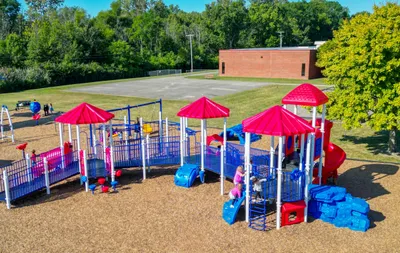
Visibility
First, visibility. The community can see that the playground exists. Parents driving by notice it. Neighbors walking their dogs see it. Families looking for a place to take their kids discover it without having to circle the building. That visibility helps create a real play space, not a hidden school asset.
Access
Second, access. A front-facing playground is typically adjacent to sidewalks and street parking, making it reachable for families who do not have cars or who do not feel welcome entering school grounds during off-hours. In close proximity to the neighborhood, the school playground feels easier to use.
Use
Third, use. When a playground is visible and accessible, the community starts showing up. Evenings. Weekends. After-school hours. Parents bring kids. Neighbors gather. The playground becomes a neighborhood gathering space that extends the school's investment far beyond the student body. It creates more room for free play, creative play, and everyday physical activity.
That last point is the one that matters most in communities without nearby parks. The playground stops being a school asset and becomes a community asset, without the playground equipment changing at all. The result is more play value from the same site.
How South View Elementary Made This Decision
South View Elementary sits in a high-poverty area of Muncie, Indiana with limited access to nearby parks or green space. Before the new playground was installed, families in the surrounding neighborhood did not have a natural gathering place for outdoor activities and simple play activities.
The superintendent, Dr. Reynolds, directed that the new playground be placed at the front of the school, facing the neighborhood, rather than tucked behind the building with the existing playground. The stated goal was community access. The school wanted the playground to serve both students during the day and the surrounding neighborhood during evenings and weekends.
Dr. Casey Smitherman, the principal, summarized the intent in an interview conducted shortly after installation: "He really wanted to make sure it was up front so that it is able to be used by all of our community, not just our school. There aren't always green spaces and parks available for everyone, and especially not those that are accessible. We really want to be a community hub."
After installation, Dr. Smitherman reported that the school has already seen community members using the playground in the evenings. The playground is now serving multiple populations across the full day, not just students during school hours. She told us about a dad who brings his daughter every evening after work now. They did not have anywhere to go before. No park in walking distance. Now they have this. That is one family. Multiply that by the whole neighborhood and you start to understand why placement is not a logistics decision. It is a community decision.
I want you to picture what that sentence actually means. A neighborhood that did not have a gathering place. A group of families who had nowhere outside to just be together after school hours. Parents who had no place to take their kids that did not require a car and gas money they did not have. And then one evening somebody walks past the school and sees that the new playground out front is not fenced off. They bring their kids the next evening. A few weeks later it is ten families. Now it is the neighborhood park the neighborhood never had. All because one person in a planning meeting asked where the playground should go instead of assuming it went in the back like every other playground.
When Does Front-Facing Placement Make Sense?
Front-facing placement is the right call in specific circumstances. It is not the right call for every school. Here are the situations where it should be seriously considered:
The school is in a community without nearby parks or accessible green space.
The school is in a high-poverty area where families have limited resources for travel to outdoor recreation.
The school has an explicit mission to serve as a community anchor beyond student hours.
The school has front-facing open space that can accommodate the playground without interfering with parking, drop-off, or traffic flow.
The school district has policies that allow community use of school grounds during non-school hours.
Front-facing placement is probably not the right call if the school is in an area with abundant nearby parks, if front-of-building space is needed for parking or traffic, or if district policy restricts community access to school grounds after hours.
What About Supervision Concerns?
The most common objection to front-facing placement is supervision during school hours. If the playground is visible from the street, the reasoning goes, teachers have to worry about strangers approaching students during recess.
This concern is real, but it is manageable. Fencing, supervision protocols, careful supervision, and clear visual separation between the playground and the street address the issue without requiring the playground to be hidden behind the building. Most schools with front-facing playgrounds use a combination of landscaping, fencing, and teacher supervision that keeps students safe while still allowing community access during off-hours.
The tradeoff is worth considering. A back-building playground is slightly easier to supervise during school hours and serves students only. A front-facing playground requires thoughtful planning during school hours and serves the entire community across the full day. For schools whose mission includes community engagement, the second option is usually the right call.
What About Integrating With an Existing Playground?
South View Elementary already had a playground on site when the new one was installed. The new play structures and related play equipment went in up front while the existing playground equipment remained in the back. Instead of creating two disconnected play areas, the layout was designed so that a teacher can see both playgrounds from one position and kids naturally move between them during recess.
The principal's assessment after installation was that it just seems like one big space. That result does not happen by accident. It requires intentional thinking about where every piece goes so a teacher can still see every kid from one spot, and how you make a kid move naturally from old to new playground equipment. Most companies drop new equipment wherever there is open ground. Designing for site cohesion is a different standard in playground design. When a site is designed thoughtfully, the play area works as one connected space instead of two separate play systems.
Your school's playground is either in the back or in the front. If it is in the back, was that a decision or a default? If you do not know the answer, somebody at your school does. Ask them. Then come back and tell me what they said. I am genuinely curious how many schools actually made the call versus how many just let it happen.


