
Swing sets benefit children by supporting physical activity, balance, coordination, sensory development, social interaction, and confidence during outdoor play. For parents and educators, the best swing set is one that matches the child’s age, size, ability level, supervision needs, and playground setting.
Swings are one of the most familiar and beloved pieces of playground equipment, but they should still be selected with care. Infants, toddlers, older children, and children with disabilities may all need different swing seats, support levels, spacing, and safety features. A well-planned swing set can support inclusive play, healthy movement, and child development, while an age-inappropriate or poorly maintained swing can increase the risk of injury.
Whether the swing set is used at a school, park, childcare center, church, or residential play area, adults should consider the type of swing seat, the swing frame, surfacing, fall zones, hardware condition, and supervision plan before children begin playing.
How Do Swings Benefit Children?
Embed this image on your site:
<a href="/a-guide-to-swing-sets-for-parents-and-educators/"><img class="lazyload" loading="lazy" title="11 Benefits of Swing Sets for Children - AAAStateofPlay.com - Infographic" src="/media/wysiwyg/images/11-benefits-swing-sets-children_85per.png" alt="11 Benefits of Swing Sets for Children - AAAStateofPlay.com - Infographic" ></a><br /><a title="AAAStateofPlay.com" href="https://www.AAAStateofPlay.com">By AAAStateofPlay.com</a>
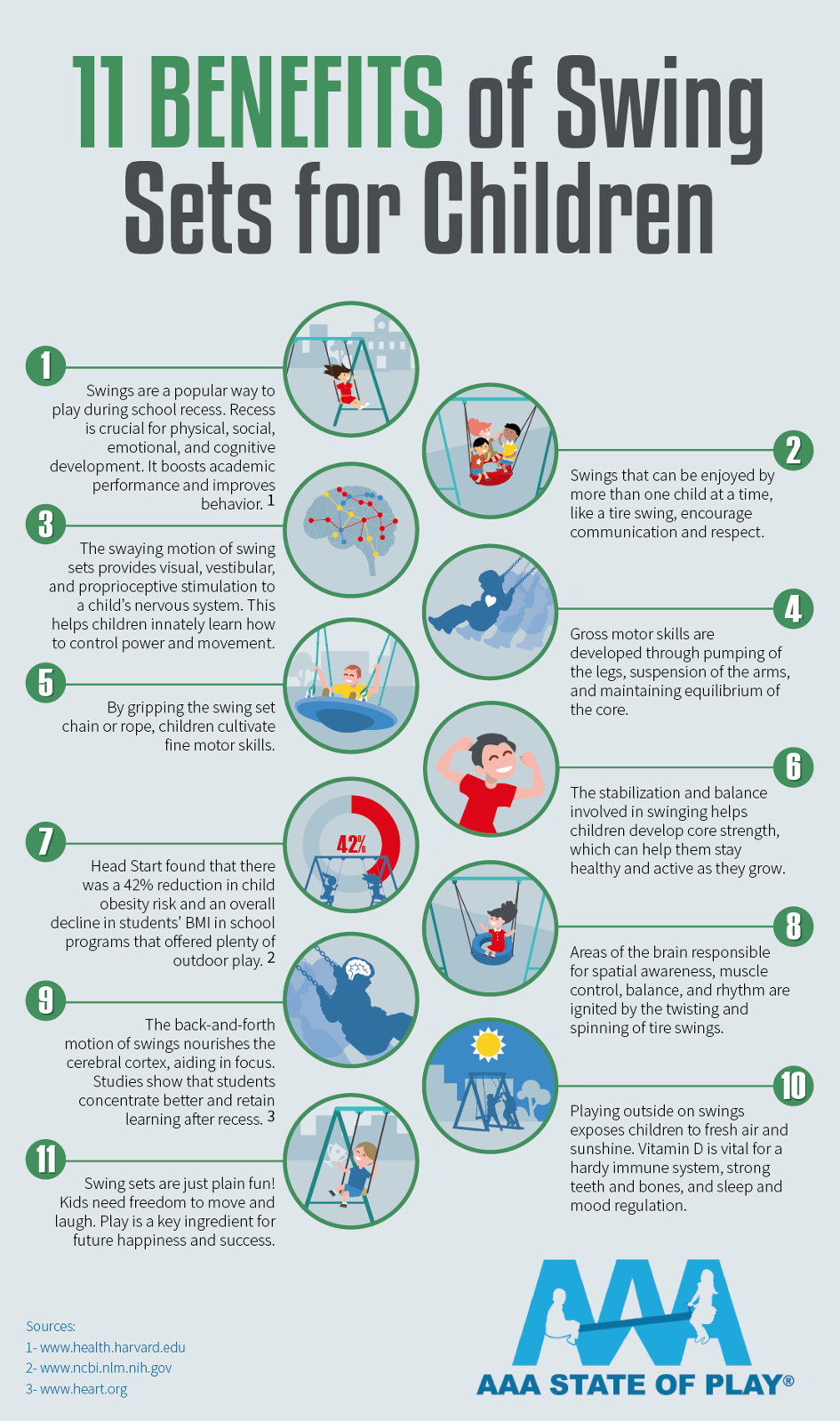
Playing on swing sets is shown to have many wonderful benefits. Swing sets exercise children’s bodies, brains, and social skills. Here are some ways that swing sets benefit children:
Countless studies have discovered that children who enjoy plenty of free play cultivate crucial skills that will help them lead healthy, happy, and productive lives.
Playing on the swings is a favorite pastime during school recess. Recess is fundamental for physical, social, emotional, and cognitive development that extends beyond formal education.
Swing sets develop crucial motor skills. For example, children must pump their legs (gross motor skill) and grip the chain (fine motor skill) to gain height. Swings also build balance and coordination.
Swing sets that can be used by more than one child, like a tire swing, can encourage social development in children, especially those with intellectual disabilities, visual impairments, and autism. Play helps to bridge the gap in communication.
The swaying motion of swinging nourishes a child’s nervous system with visual, vestibular, and proprioceptive stimulation. By playing on swings, children innately learn how their bodies move in space and how to better control them.
The back-and-forth motion of swings stimulates the cerebral cortex, aiding in focus. This may be why children who participate in recess perform better academically.
Twisting and spinning tire swings tap into areas of the brain that are important for spatial awareness, muscle control, balance, and rhythm.
Swing sets provide healthy risk during play, which child development professionals believe is invaluable for boosting confidence, independence, and creativity.
Outdoor play is a key ingredient to healthy physical, emotional, and mental development. As children soar through the air on swings, they take in fresh air and bask in immune-fortifying sunshine.
Choosing the Right Swing Set
What Is the Best Swing Set for Babies?
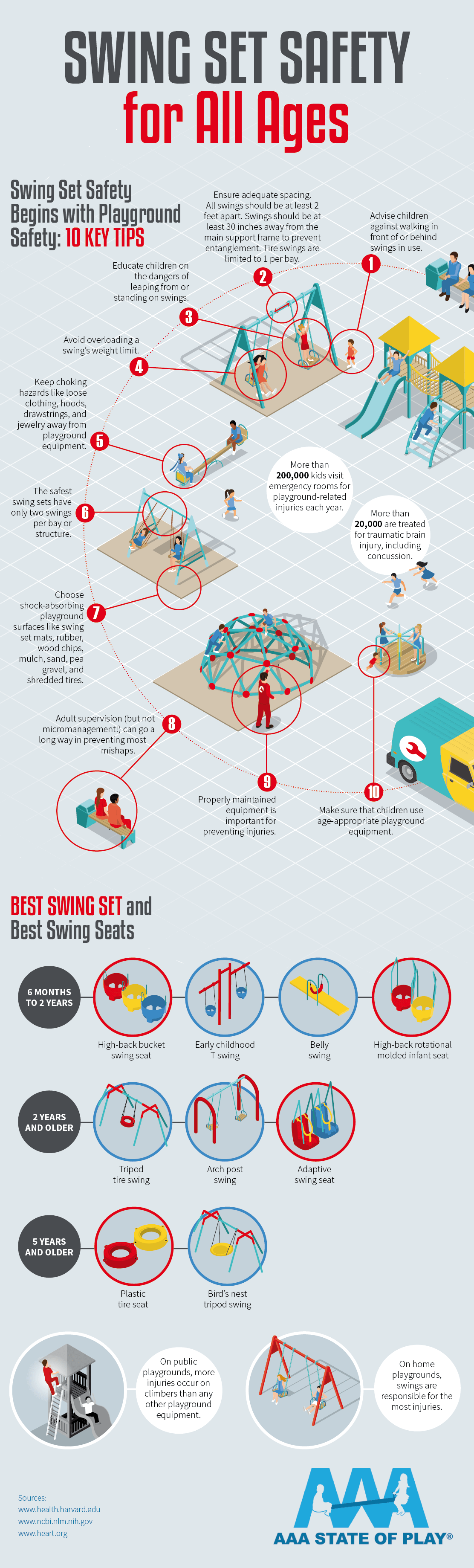
A high-back rotational molded infant seat is ideal for infants as young as 6 months. The extra-wide seat is designed to gravitationally correct when a child is swinging. High-back bucket swing seats are also an excellent choice, as they’re designed to prevent children from squirming out of the seat while providing safe back support. Make sure that the swing set and swing seats meet the ASTM standards for commercial use.
What Is the Best Swing Set for Toddlers?
High-back bucket swing seats are suitable for toddlers ages 12 to 36 months old. Not only do they keep children secure and comfortable, but the high back provides ample room for pushing the swing. This type of seat is good for introducing children to swings who are not able to buckle seat belts yet. Tire swing gliders are great for preschool children, as they are low to the ground and can be used by multiple children, encouraging parallel and cooperative play.
What Is the Best Swing Set for Older Children?
As children get older, flat swing seats and belt swing seats are popular options that offer freedom, momentum, and excitement. Heavy-duty swing set posts allow you to create space for inclusion and diversity; tire swings, adaptive swing seats, and inclusive swing seats can provide joy and enrichment for children of all abilities.
What Is the Best Swing Set for Small Yards?
Early childhood T-swings with bucket seats offer plenty of space for swinging while having a small footprint. They are suitable for children from 6 months to 5 years old. Swing sets that are built into a single playground structure can also be a good choice for home playgrounds.
Playground Swing Set Safety Tips
Embed this image on your site:
<a href="/a-guide-to-swing-sets-for-parents-and-educators/"><img class="lazyload" loading="lazy" title="Swing Set Safety for All Ages - AAAStateofPlay.com - Infographic" src="/media/wysiwyg/images/swing-set-safety-all-ages_comp.png" alt="Swing Set Safety for All Ages - AAAStateofPlay.com - Infographic" ></a><br /><a title="AAAStateofPlay.com" href="https://www.AAAStateofPlay.com">By AAAStateofPlay.com</a>
Swing sets are a fun and dynamic part of any playground, but they are not without risks. Here are some tips about swing set safety:
Make sure to choose a swing set that is appropriate for the age of the child or children playing on it.
Adequate spacing is critical for swing safety. All swings should be at least two feet apart from each other. Swings should be at least 30 inches away from the main support frame to prevent entanglement.
Make sure that swings are at least eight inches off the ground.
The safest swing sets have only two swings per bay.
Safe playground surfaces should include at least 12 inches of cushioning materials such as wood chips, rubber mulch, sand, mats, or poured surfacing. Swing set mats can help to create soft landing zones.
Inspect the structure and hardware frequently for signs of weakness, rusting, or looseness.
Educate children on the dangers of leaping from swings or standing or kneeling on them.
Avoid seating two or more on a single swing unless it is designed for that purpose, as swings are designed to safely hold a certain weight limit.
Advise children against walking in front of or behind swings that are in use.
Leave necklaces, bracelets, and clothing with drawstrings at home to prevent tangling.
Check the temperature of playground equipment and surfaces before letting kids play to prevent burns.
Adult supervision can help prevent injuries by making sure children are using playground equipment properly.
Swing sets can be one of the most valuable parts of a playground when they are selected, installed, and supervised correctly. Parents and educators should choose swing seats based on age and ability, provide enough spacing between swings, maintain proper protective surfacing, inspect hardware regularly, and teach children how to use swings safely.
A safe swing area should also account for the outdoor environment. Children need shade, water, sunscreen, and rest breaks during hot weather, especially when play areas are exposed to direct sun. By combining age-appropriate swing equipment with safe surfacing, routine inspections, and active supervision, adults can help children enjoy the developmental benefits of swinging while reducing preventable playground risks.